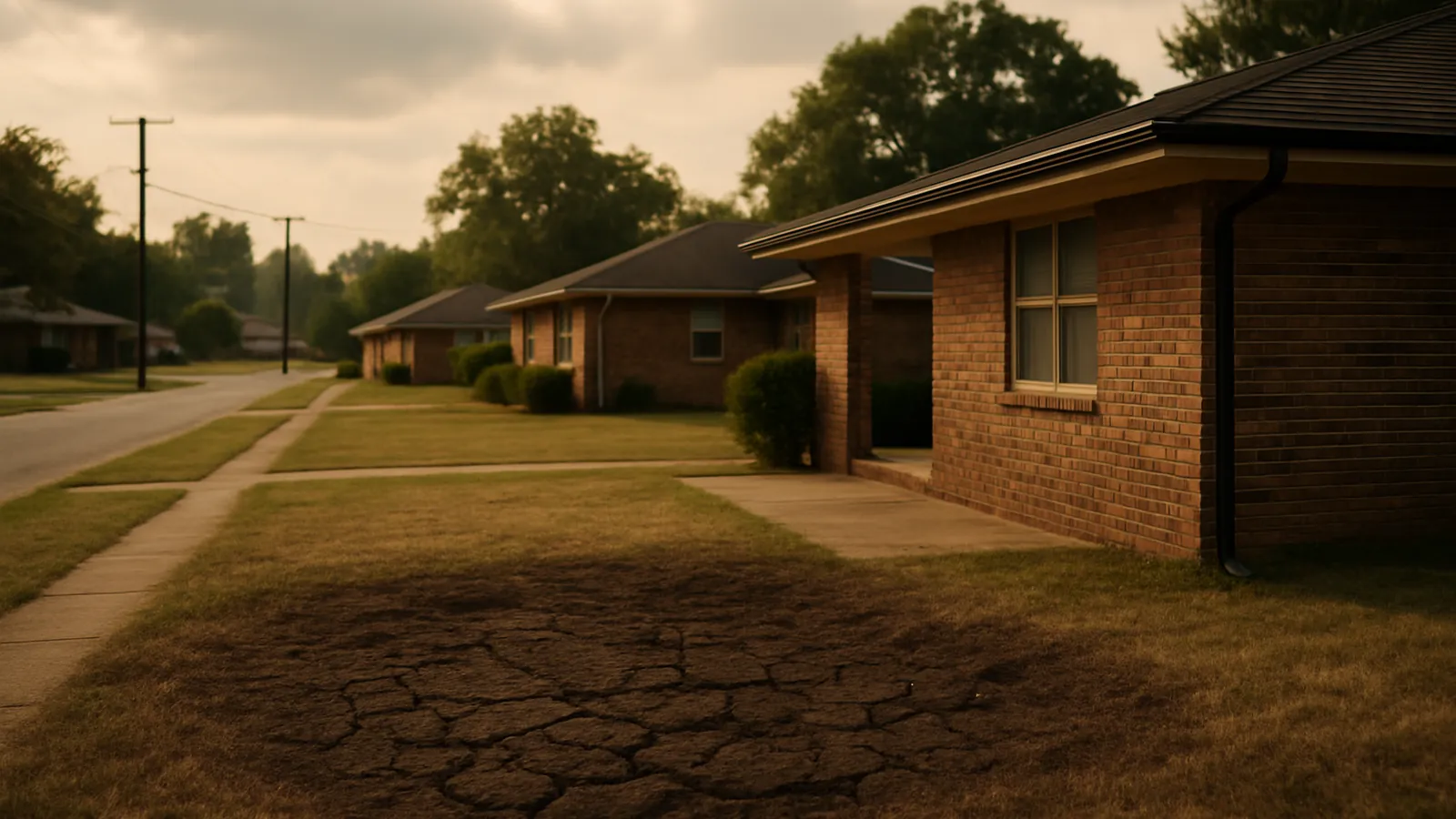
Helical and push piers for Montgomery foundation repair both run $1,200–$3,000 per pier; the choice is engineering. Push piers drive to logged refusal using the house’s weight — suited to heavier masonry — while helicals torque to measured capacity, fitting slab ranches, pier-and-beam work, and additions.
How each proves capacity, and how Montgomery’s split housing stock picks between them.
Two proofs of the same promise
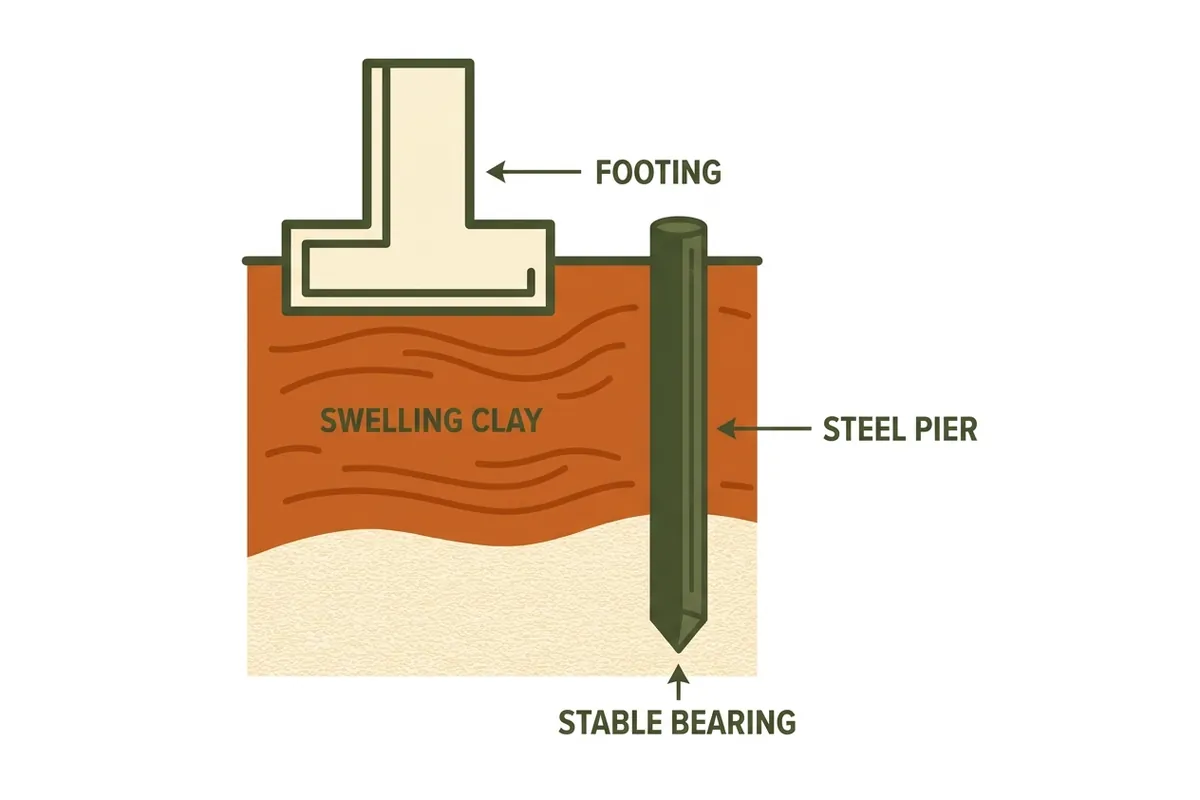
A pier’s job on vertisol is to carry load below the active zone — beneath the depth where the Black Belt’s wet-dry swing operates — to bearing that ignores the calendar. A push pier is hydraulic steel driven beside the footing, using the structure as reaction weight until it refuses to advance; the logged refusal pressure is its proof. A helical pier screws in on welded plates, and installation torque correlates with capacity — the gauge proves each pier as it turns, no house weight required.
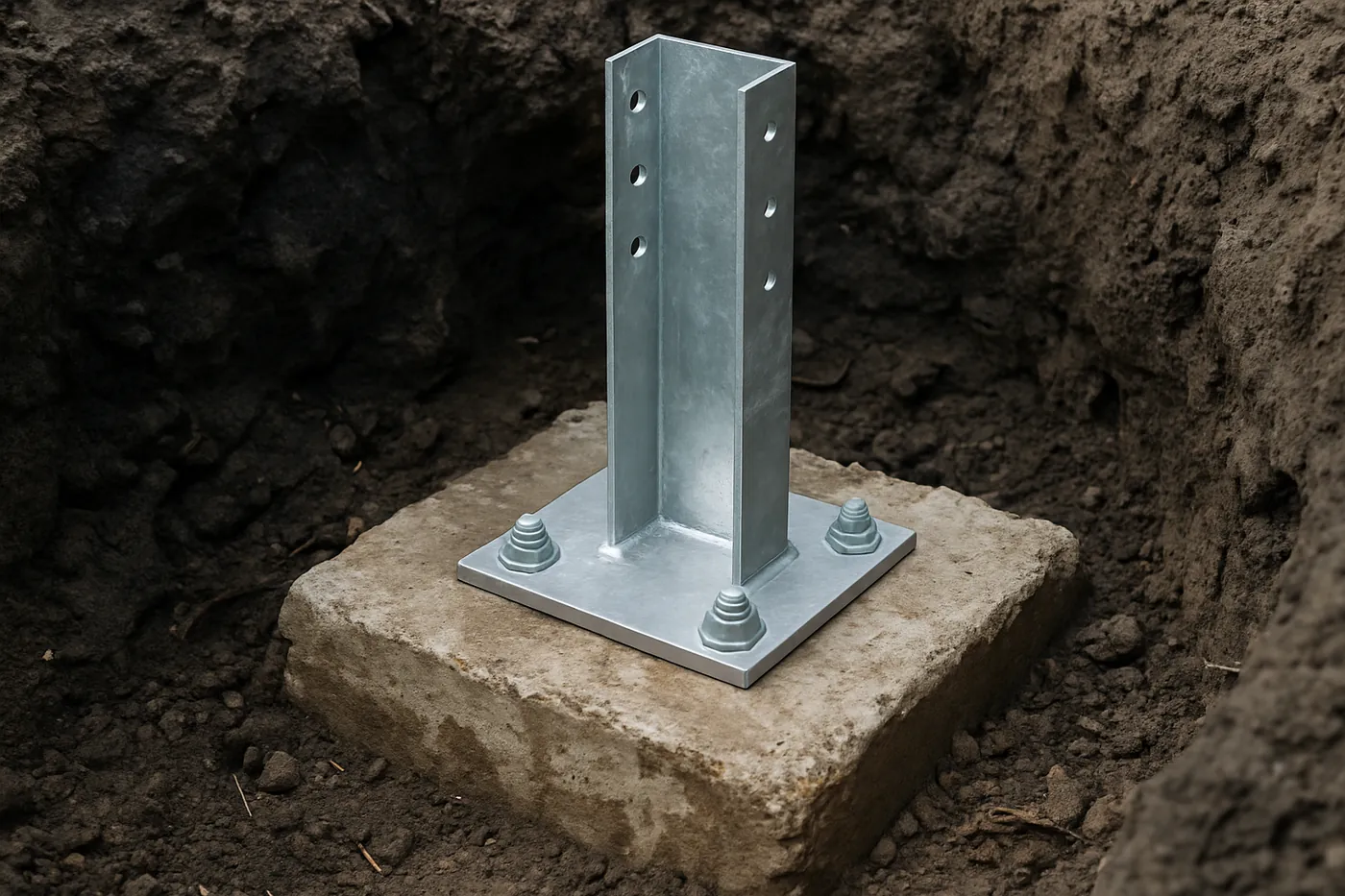
Side by side
| Push piers | Helical piers | |
|---|---|---|
| Advance | Driven against the structure’s weight | Rotated to specified torque |
| Proof | Refusal pressure, logged per pier | Installation torque, logged per pier |
| Needs house weight | Yes | No |
| Montgomery fit | Heavier masonry perimeters | Slab ranches, pier-and-beam interiors, porches, additions |
| New construction | No | Yes — proven before framing |
| Cost | $1,200–$3,000 per pier; depth to bearing sets the spread | |
What the housing split does to the decision
Montgomery argues both cases. The mid-century slab suburbs are light construction where push piers struggle toward honest refusal and helical torque is the truthful proof. The in-town pier-and-beam stock is lighter still — and often needs no deep steel at all, since interior pier corrections do the job — but where a perimeter or a stubborn footing needs support through active vertisol, helicals usually get the call. Heavier brick perimeters are the push-pier case. Mixed scopes run one warranty with both logs. Whether piers are the right repair at all is the settlement diagnosis; install mechanics live on the piering page.
Reading a pier bid like a skeptic
Ask three things of every bid, including ours: the per-pier proof (torque or refusal, logged), the depth assumption and what happens to price beyond it, and which structure at which locations justifies the pier type chosen. On vertisol, add a fourth: how the scope handles the water, since steel without drainage correction leaves the cycle running around it. Honest answers converge; the arithmetic they converge to is in the cost guide.
What the pier warranty is actually worth
Read the warranty before the price. It covers the piers’ capacity — the supported section carrying its design load — not the whole house, and not the parts nobody piered. Four questions separate a real warranty from a brochure: is it transferable, does the transfer cost a fee, does it cover the piered section or the structure, and does it survive the contractor closing its doors (third-party-backed warranties do). On the most expansive soil in this fleet, ask a fifth: whether the warranty depends on drainage or moisture maintenance you owe. That clause is common and enforced. Keep the depth and torque log with it — on vertisols the depth the pier reached is the entire reason the warranty means anything.
Pier questions, straight answers
Do helical and push piers cost the same in Montgomery?
Yes — $1,200 to $3,000 per pier for either, with the spread driven by depth to stable bearing and access rather than steel. Depth varies between the chalk uplands and the creek-bottom clays, and deeper bearing means more sections at either type. The real choice is which proof your house can deliver: refusal needs weight, torque doesn't.
Which type fits the slab suburbs?
Helical, usually. A single-story slab ranch east of town is light — a push pier reacting against it can run out of house before honest refusal. Helicals torque to a measured capacity independent of the structure, which also makes them the default under porches, stoops, and additions everywhere in the metro.
Which type fits the in-town pier-and-beam stock?
Often neither — and that honesty matters. Pier-and-beam settlement is usually fixed at individual interior piers with pads and releveling, no deep steel at all. Where a perimeter wall or stubborn pier does need deep support through active vertisol, helicals typically get the call: wood-framed houses rarely carry the weight push piers want.
How deep do piers go here?
To proof, not to a promised footage. The vertisol's active zone — the depth the wet-dry cycle actually works — has to be cleared, and then bearing answers where it answers: chalk in some parts of the metro, firm strata in others. The per-pier log, refusal pressure or final torque, is your receipt that each one got there.
Can both types go on one job?
Routinely. An in-town house with a heavy brick perimeter and a light rear addition might take push piers along the original wall and helicals under the addition — one scope, one warranty, both logs. The structure at each location picks the pier; the survey picks the locations. Forcing one type everywhere serves the truck, not the house.
How long does the install take, and do we have to move out?
Most residential pier jobs run two to five days depending on pier count and access, and nearly everyone stays in the house. Expect equipment in the yard, excavation at the footings, and noise during working hours. Interior disruption is usually limited unless the scope includes a basement wall. The yard takes the visible hit, and restoration should be written into the scope.
Get a free Montgomery foundation evaluation
Tell us what the house is doing — stair-step cracks, doors that stick every August, sloping floors, separating trim — and we’ll schedule an evaluation with photos and measurements. We reply the same business day.